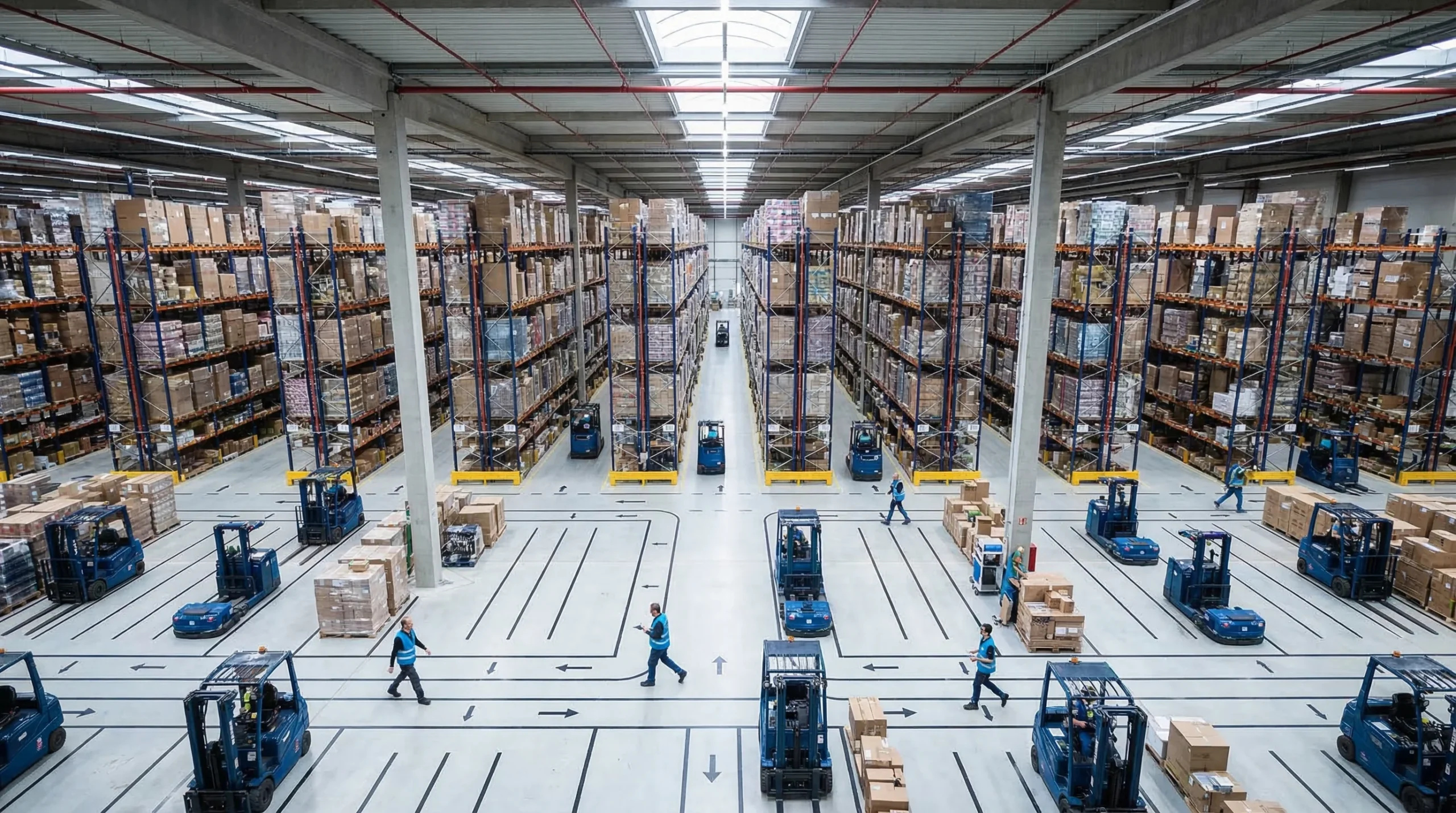

Order fulfillment is a critical process for businesses of all types, from ecommerce retailers to wholesalers. Whether you’re shipping direct to consumers or fulfilling bulk orders for distributors, an efficient and well-optimized order fulfillment process can make or break your business. This guide will show you how to implement fulfillment optimization strategies to boost efficiency and improve customer satisfaction across industries.
Key Takeaways
- A well-executed order fulfillment process, from receiving inventory to shipping, is critical for customer satisfaction and loyalty.
- Automation, optimized inventory management, and enhanced communication are key to boosting operational efficiency and cutting fulfillment costs.
- The right fulfillment strategy—whether in-house, using a third-party logistics provider (3PL), or dropshipping—depends on your order volume, customer expectations, and scalability needs.
Smarter Warehouse Management Starts Here
Logimax WMS delivers real-time visibility, automated workflows, and seamless ERP integration for warehouses of every size.
Request a Demo
Understanding Order Fulfillment

Order fulfillment is the process of completing sales by ensuring that sold items are delivered to customers efficiently. It involves several steps, including:
- Storing inventory
- Selecting items
- Packing them
- Shipping to customers
In today’s fast-paced ecommerce world, where giants like Amazon set high benchmarks, customers expect efficient and accurate order fulfillment. Meeting these high expectations requires a well-managed fulfillment process that leverages inventory management systems and order processing technologies. Effective fulfillment optimization is crucial for maintaining competitiveness and customer loyalty, especially as fast delivery becomes the norm.
Key Steps in the Order Fulfillment Process
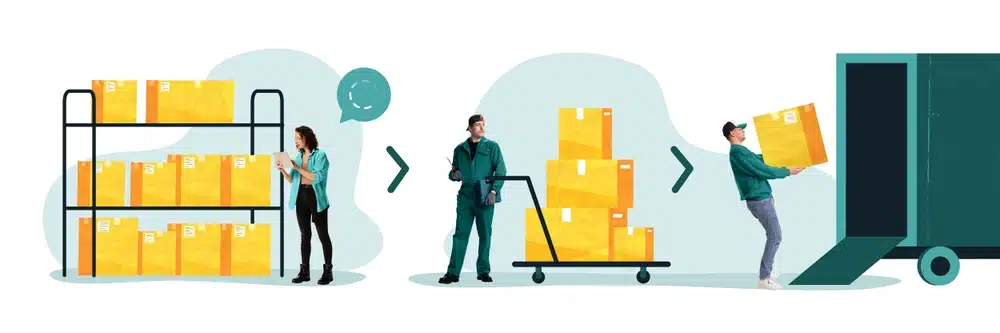
The order fulfillment process involves several critical stages, including receiving, processing, picking, packing, and shipping goods. Each step is vital and contributes to the overall efficiency and effectiveness of the fulfillment process.
Receiving Inventory
Receiving inventory is the first step in the order fulfillment process. It involves multiple actions to ensure the correct products are stored efficiently:
- Acceptance of Shipments:
- Unload incoming shipments and check them against purchase orders to verify accuracy.
- Inspection for Damages:
- Inspect products for any signs of damage during shipping.
- Inventory Matching:
- Ensure the items received match the supplier’s order in terms of quantity, quality, and specifications.
- Storing Inventory:
- Properly store the products in designated warehouse locations.
Optimizing the receiving process minimizes the risk of damage and ensures products are quickly ready for the next steps in order fulfillment.
Storing Inventory
Efficient inventory storage plays a crucial role in speeding up order picking and reducing errors. Here are key actions for storing inventory effectively:
- Organize Inventory Strategically:
- Store frequently picked items in easily accessible areas to speed up the picking process.
- Categorize Items:
- Group similar or related products together for better flow during picking and packing.
- Use Inventory Management Tools:
- Leverage real-time inventory management systems to track product locations and quantities accurately.
- Regular Audits:
- Conduct regular audits to ensure inventory accuracy and prevent stock discrepancies.
Proper storage optimizes warehouse flow and minimizes picking errors, contributing to faster fulfillment.
Order Processing
Order processing begins when an order is received and consists of several critical steps:
- Order Verification:
- Confirm customer details, including delivery address and payment status.
- Ensure that the products ordered are available in stock.
- Order Management with a WMS:
- Using a WMS with order management features streamlines the flow of information between systems and teams.
- Automatically communicate order details, product availability, and shipping preferences to reduce processing errors.
- Picking Inventory:
- Zone Picking: Assign workers to specific zones to reduce travel time.
- Batch Picking: Pick similar items from multiple orders in one trip to boost efficiency.
- Discrete Picking: Pick items one order at a time to ensure accuracy, particularly for complex or high-value orders.
- Packing Orders:
- Secure items with appropriate packing materials.
- Include necessary documentation, like packing slips or return labels.
- Label packages clearly and accurately to ensure smooth delivery.
Shipping Orders
The final step in the order fulfillment process is shipping, and several key actions can help ensure customer satisfaction:
- Selecting a Shipping Carrier:
- Choose carriers that offer the best balance of cost and speed, especially for different regions or last-mile logistics.
- Many businesses use multiple carriers to optimize delivery based on location.
- Labeling and Documentation:
- Ensure shipping labels are accurate and clearly display the destination.
- Include any necessary customs forms or documentation for international orders.
- Pickup and Delivery:
- Coordinate with carriers for timely pickups or drop-offs.
- Ensure packages are securely packed to avoid damage during transit.
- Tracking and Communication:
- Provide customers with tracking information to keep them updated and build trust.
- Use automated systems to notify customers of delays or other issues, improving the customer experience.
Leveraging a WMS that integrates with shipping features can help streamline this process and ensure orders are delivered efficiently.
Benefits of Efficient Order Fulfillment
A well-executed order fulfillment process offers several key benefits:
- Cost Reduction:
- Reduces labor and operational overhead.
- Minimizes shipping expenses through streamlined packaging and fewer picking errors.
- Allows businesses to focus on core operations while leveraging third-party logistics providers to lower costs.
- Enhanced Customer Satisfaction:
- Improves accuracy in order fulfillment, resulting in fewer returns.
- Ensures timely deliveries, which is essential for maintaining a competitive edge.
- Builds customer trust with transparency in delivery times and tracking.
- Competitive Advantage:
- Faster order fulfillment enables quicker delivery, boosting customer satisfaction.
- Reduces operational costs, leading to more competitive pricing and better profit margins.
- Streamlined fulfillment processes can set you apart from competitors, fostering long-term success.
Common Challenges in Order Fulfillment
Businesses face several challenges during the order fulfillment process. Here are common hurdles and potential solutions:
- High Order Volumes: Seasonal spikes or promotions can overwhelm fulfillment operations.
- Solution: Automate repetitive tasks, optimize warehouse layout, or partner with third-party logistics providers (3PLs) to handle peak demand.
- Inventory Accuracy: Inaccurate stock levels lead to stockouts or overstocking, impacting customer satisfaction and revenue.
- Solution: Implement real-time inventory tracking and conduct regular audits to ensure accuracy.
- Delivery Expectations: Meeting customer demands for fast, reliable deliveries is increasingly difficult, especially for international shipments.
- Solution: Use multiple carriers, localize inventory, and optimize shipping strategies to improve delivery times and reliability.
Best Practices for Optimizing Order Fulfillment

Here are some best practices to improve your order fulfillment process:
- Implement Automation:
- Use fulfillment technologies like a warehouse management system (WMS) to automate inventory tracking and order picking.
- Automate shipment tracking and notifications to reduce errors and improve efficiency.
- Optimize Inventory Management:
- Leverage inventory management systems with predictive analytics to maintain optimal stock levels.
- Use real-time inventory systems to avoid stockouts and overstocking.
- Consider localizing inventory for faster shipping times.
- Enhance Communication:
- Improve communication between departments with real-time updates on inventory and orders.
- Provide customers with tracking details and timely notifications about their orders.
Choosing the Right Order Fulfillment Strategy
Choosing the right order fulfillment strategy is crucial for supporting long-term business growth and operational efficiency. The most common strategies are in-house fulfillment, outsourcing to third-party logistics (3PL) providers, and dropshipping. Each option has its own advantages and challenges, and the best choice depends on factors like order volume, customer expectations, and the need for scalability.
In-House Fulfillment
In-house fulfillment, also known as merchant fulfillment, involves the seller managing the entire process themselves. This option is typically more cost-effective for small businesses with low order volumes. It allows for greater control over the fulfillment process, which is particularly beneficial for products that are custom-made, gift-wrapped, or fragile.
However, as the business grows, in-house fulfillment can become both costly and difficult to scale. For companies shipping only a few orders each week, the need for a full inventory or warehouse management system may be minimal. But for businesses experiencing growth, a robust warehouse management system (WMS) like Logimax WMS can help optimize fulfillment operations by providing real-time inventory management and streamlining order processing.
While in-house fulfillment offers control and customization, it may become unsustainable as order volumes increase and operations grow more complex. Implementing a scalable WMS solution can help businesses manage this growth more efficiently.
Third-Party Logistics (3PL)
A third-party logistics (3PL) provider manages the entire order fulfillment process on behalf of businesses. These providers offer specialized infrastructure and services that make handling large order volumes more efficient. By partnering with a 3PL, ecommerce retailers can focus on strategic business growth while the logistics provider takes care of shipping, returns processing, and scaling solutions as order volumes fluctuate.
One of the key considerations when choosing a 3PL provider is trust. A 3PL partner must be capable of handling your inventory efficiently and ensuring that the customer experience is not compromised. This is particularly important for fast-growing ecommerce businesses where order volumes are increasing and customer satisfaction is a priority.
By leveraging 3PL capabilities, businesses can enjoy significant efficiencies, cost savings, and access to global fulfillment networks.
Dropshipping
Dropshipping is a fulfillment model in which businesses don’t hold inventory or handle shipping directly. Instead, the manufacturer or supplier produces, stores, and ships the products to customers after receiving the order from the merchant. This allows businesses to sell products without needing to manage physical inventory.
However, dropshipping comes with its own set of challenges. Merchants have little to no control over the fulfillment process, which can affect customer satisfaction. Additionally, since shipping is dependent on third-party suppliers, delivery times may be longer, and costs can be higher compared to other fulfillment methods.
While dropshipping simplifies inventory management and reduces upfront costs, it can complicate efforts to meet customer expectations for timely and reliable delivery.
Leveraging Technology for Better Order Fulfillment
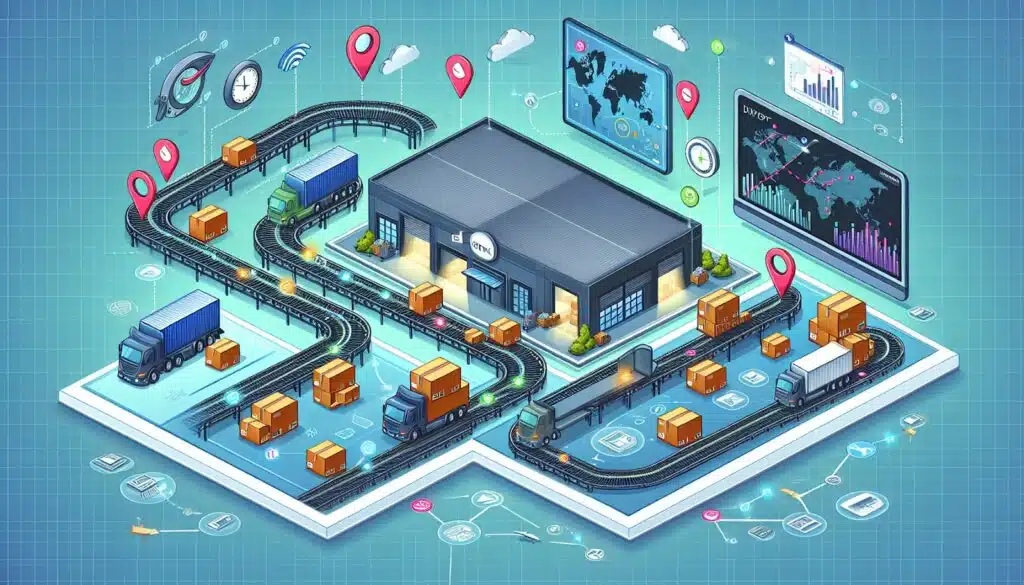
Technology plays an essential role in improving order fulfillment by enabling more accurate demand forecasting and efficient management of order processing. From Warehouse Management Systems (WMS) to Artificial Intelligence (AI), the right technologies can significantly enhance operational efficiency and customer satisfaction.
Warehouse Management Systems (WMS)
A Warehouse Management System (WMS) is a powerful tool that facilitates real-time inventory tracking, improving accuracy and reducing errors throughout the fulfillment process. WMS systems help implement advanced picking strategies such as wave, zone, and batch picking, which can minimize travel time for warehouse staff and improve overall productivity.
By optimizing inventory management and streamlining warehouse operations, a WMS leads to increased operational efficiency and higher levels of customer satisfaction.
Transportation Management Systems (TMS)
Transportation Management Systems (TMS) streamline shipping by optimizing route planning and improving carrier selection. TMS helps businesses reduce transportation costs through better load optimization and real-time tracking of shipments. By negotiating better carrier rates and optimizing delivery routes, a TMS enables significant cost savings while maintaining shipping efficiency.
The result is enhanced shipping operations that help businesses lower their overall logistics costs while improving delivery performance.
Artificial Intelligence (AI)
While Artificial Intelligence (AI) is starting to make its way into some warehouse operations, its widespread adoption is still on the horizon. AI offers promising benefits by automating tasks like order verification, product matching, and optimizing picking routes. As the technology matures, AI-driven tools will likely play a much larger role in order fulfillment by reducing lead times and ensuring more accurate deliveries.
AI also has the potential to enhance inventory management through predictive analytics, helping businesses manage stock levels more efficiently. However, many warehouses are still in the early stages of implementing AI, and we can expect to see its role in order fulfillment grow significantly in the coming years as the technology becomes more accessible and scalable.
Order Fulfillment Strategies: Picking the Right Approach for Your Operation
Choosing the right order fulfillment strategy has a direct impact on cost, speed, and customer satisfaction. The best approach depends on your order volume, product mix, customer expectations, and available resources. Here are the most widely used fulfillment strategies and when to apply each.
Discrete (Single-Order) Picking
Pickers fulfill one order at a time from start to finish. This is the simplest strategy and works well for low-volume operations or high-value items requiring careful handling. The downside: pickers travel the same paths repeatedly, creating inefficiency at scale.
Batch Picking
Pickers collect items for multiple orders in a single warehouse pass, consolidating similar picks into one trip. Batch picking reduces travel time significantly — often by 20–40% — and works best when orders share many of the same SKUs. It requires a sortation step after picking to separate items by order.
Zone Picking
The warehouse is divided into zones, and each picker is responsible for their assigned zone only. Orders move through zones sequentially (or in parallel with a sort), with each picker adding their items. Zone picking reduces congestion in large facilities, speeds up individual picks, and allows pickers to develop deep familiarity with their area.
Wave Picking
Wave picking schedules groups of orders (waves) to be picked and released at specific times throughout the day — typically aligned with carrier pickup windows or shipping deadlines. This allows warehouse managers to balance labor and dock capacity. Wave picking is common in high-volume distribution centers and is most effective when combined with a WMS that can optimize wave sizes dynamically.
Pick-and-Pass
In this strategy, a tote or order container moves along a conveyor or cart route, and each picker adds items as it passes through their section. Pick-and-pass works well for e-commerce operations with many small orders and is naturally compatible with automation and conveyor-based systems.
How to Choose the Right Fulfillment Strategy
Use this framework to select your approach:
- Under 100 orders/day: Discrete picking is typically sufficient
- 100–1,000 orders/day: Batch or zone picking delivers meaningful efficiency gains
- 1,000+ orders/day: Wave picking with WMS optimization and/or automation is standard
- High SKU diversity: Zone picking reduces congestion and travel
- Many orders sharing SKUs: Batch picking minimizes redundant travel
Most modern warehouse management systems, including Logimax WMS, can automate strategy selection based on order characteristics, carrier deadlines, and real-time floor conditions.
Order Fulfillment Metrics: KPIs You Should Be Tracking
You cannot improve what you do not measure. Tracking the right order fulfillment metrics allows you to identify bottlenecks, benchmark performance, and set targets for improvement. The following KPIs are the most important for fulfillment operations:
Order Accuracy Rate
The percentage of orders shipped without errors (wrong item, wrong quantity, wrong address). Industry benchmark: 99.5%+. Below 99% signals a significant picking or packing process issue.
Order Cycle Time
The time from when a customer places an order to when it ships. Shorter cycle times improve customer satisfaction and reduce the risk of cancellations. Break this down by stage (order processing, pick, pack, ship) to isolate where time is being lost.
On-Time Shipment Rate
The percentage of orders shipped on or before the committed ship date. This is a leading indicator of on-time delivery and customer experience. Target: 98%+ for most operations.
Inventory Accuracy
The match between your recorded inventory and physical inventory. Low inventory accuracy (below 98%) is a leading cause of fulfillment delays, stockouts, and incorrect orders. Cycle counting and barcode scanning during receiving are the primary tools for maintaining high accuracy.
Cost Per Order
Total fulfillment cost (labor, packaging, shipping, overhead) divided by number of orders. Tracking cost per order over time reveals whether operational improvements are translating to real savings. Benchmark against industry peers to determine whether your costs are competitive.
Return Rate
The percentage of shipped orders that are returned. High return rates can signal product quality issues, inaccurate product descriptions, or fulfillment errors. eCommerce operations typically see return rates of 15–30%, while B2B wholesale is much lower.
Returns Management and Reverse Logistics
Returns are an unavoidable part of order fulfillment — especially in eCommerce, where return rates average 20–30%. A poorly managed returns process increases costs, ties up inventory, and damages customer trust. A well-managed one can actually become a competitive advantage.
The Returns Fulfillment Process
An effective returns management process typically includes:
- Return authorization: Customer initiates return via portal or customer service; system generates RMA (Return Merchandise Authorization)
- Receiving and inspection: Returned item arrives at warehouse, condition is assessed
- Disposition decision: Restock, refurbish, liquidate, or dispose based on condition and policy
- Inventory update: WMS updates inventory records immediately upon receiving
- Refund or exchange processing: Customer resolution is triggered
How a WMS Improves Returns Processing
A warehouse management system streamlines reverse logistics by automating disposition rules, generating return receipts, and updating inventory in real time. Without a WMS, returns often sit in a staging area for days before being inspected and restocked, creating invisible inventory that cannot be resold. With Logimax WMS, returns are processed with the same efficiency as inbound receipts, with automatic lot and serial number tracking preserved through the return cycle.
Order Fulfillment for eCommerce vs. B2B Wholesale
eCommerce and B2B wholesale fulfillment share the same core steps but differ dramatically in execution, volume patterns, and customer expectations.
eCommerce Order Fulfillment
eCommerce fulfillment is characterized by high order volume, low unit counts per order, tight delivery SLAs, and direct-to-consumer shipping. Key requirements include:
- Multi-carrier rate shopping and label generation
- Same-day or next-day pick, pack, and ship capability
- SKU proliferation management (thousands of active SKUs)
- Integration with marketplaces (Amazon, Shopify, Walmart)
- Consumer-friendly returns processing
B2B Wholesale Fulfillment
B2B wholesale fulfillment typically involves fewer, larger orders — pallet-level shipments to retail stores, distributors, or other businesses. Key requirements include:
- EDI compliance for trading partner order processing
- Pallet building and freight optimization
- Lot number and expiration date tracking
- Advance Ship Notices (ASNs) and compliance labeling
- Customer-specific packing and labeling requirements
Many warehouses handle both channels simultaneously — a pattern known as omnichannel fulfillment. Managing both efficiently requires a WMS that can handle different order types, picking methods, and shipping rules within the same operation, routing each order through the appropriate workflow automatically.
Optimize Your Order Fulfillment with Logimax WMS
To truly boost efficiency and customer satisfaction in your order fulfillment process, implementing the right technology is key. Logimax Warehouse Management System (WMS) offers powerful tools that streamline every step of the fulfillment process, ensuring accuracy, speed, and cost savings. Here are some top features that make Logimax WMS an ideal solution for improving order fulfillment:
- Advanced Inventory Management: Real-time tracking of inventory levels prevents stockouts and overstocking, ensuring that your warehouse operates smoothly and keeps up with demand.
- Optimized Picking and Packing: Leverage advanced picking strategies like batch, zone, and wave picking to speed up order processing, reduce errors, and improve labor efficiency.
- Seamless Integration: Logimax WMS integrates easily with Transportation Management Systems (TMS), Enterprise Resource Planning (ERP) platforms, and other key supply chain systems, allowing for seamless communication and coordination.
- Scalability for 3PL and In-House Operations: Whether you manage fulfillment internally or through a third-party logistics (3PL) provider, Logimax WMS scales to meet your business needs, handling fluctuations in order volume and complexity with ease.
By implementing Logimax WMS, you can enhance your fulfillment process, reduce operational costs, and deliver exceptional customer experiences. Contact us today to learn more about how Logimax WMS can help optimize your operations.
Summary
An optimized order fulfillment process is essential for any business looking to achieve long-term success. By improving each step, from receiving inventory to shipping orders, and incorporating advanced fulfillment technologies like a WMS, businesses can reduce costs, enhance customer satisfaction, and gain a competitive advantage. Choosing the right fulfillment strategy and leveraging the power of inventory management systems and order processing tools will ensure your operations are scalable and efficient.
Looking to streamline your order fulfillment process? Discover how Logimax WMS can help optimize every step, from receiving inventory to shipping. Contact us today to learn more.
Frequently Asked Questions
What is order fulfillment?
Order fulfillment is the complete process of receiving, processing, and delivering orders to customers. It includes receiving inventory from suppliers, storing products in a warehouse, picking items when orders come in, packing them securely, and shipping them to the customer. An efficient order fulfillment process is essential for customer satisfaction and business growth.
What are the key steps in the order fulfillment process?
The order fulfillment process consists of five key steps: 1) Receiving – accepting and inspecting incoming inventory from suppliers; 2) Storage – organizing products in the warehouse for efficient retrieval; 3) Picking – selecting the correct items for each order; 4) Packing – securely packaging items for shipment; and 5) Shipping – delivering orders to customers through carriers.
What is the difference between in-house fulfillment and 3PL?
In-house fulfillment means managing all fulfillment operations internally using your own warehouse, staff, and systems. This offers more control but requires significant investment. Third-party logistics (3PL) involves outsourcing fulfillment to a specialized provider who handles storage, picking, packing, and shipping on your behalf. 3PL is ideal for businesses looking to scale without the overhead of managing their own warehouse operations.
How can a WMS improve order fulfillment?
A Warehouse Management System (WMS) improves order fulfillment by automating inventory tracking, optimizing pick paths, reducing errors, and providing real-time visibility into stock levels. WMS software streamlines receiving, storage, and shipping processes, helping warehouses fulfill orders faster and more accurately while reducing labor costs and improving customer satisfaction.
What picking strategies can improve fulfillment efficiency?
Several picking strategies can boost fulfillment efficiency: Batch picking groups multiple orders together to reduce travel time; Zone picking assigns workers to specific warehouse areas; Wave picking schedules picks in timed waves to coordinate with shipping schedules; and Pick-to-light uses visual indicators to guide workers. The best strategy depends on your order volume, SKU count, and warehouse layout.