
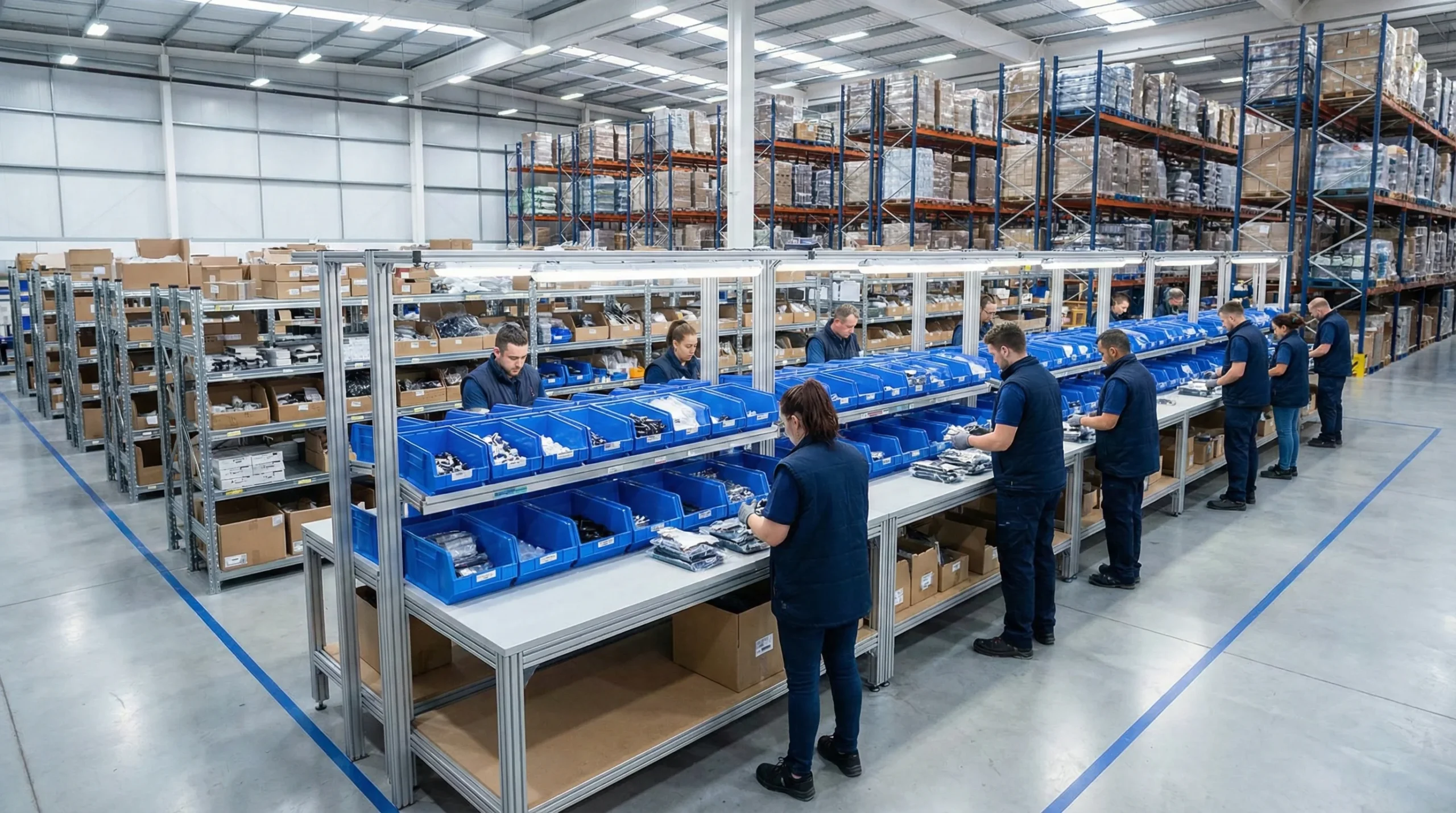
What is Warehouse Kitting?
Warehouse kitting is the process of pre-assembling individual items into ready-to-ship packages or product sets before receiving customer orders. Rather than picking each component separately when an order arrives, warehouse teams gather related products, promotional materials, and accessories into kits that can be stored as single units and shipped immediately upon purchase.
This strategy transforms multiple SKUs into a single, sellable unit that streamlines fulfillment operations. For example, a computer retailer might create kits containing a laptop, mouse, carrying case, and setup guide. Instead of storing these items separately and picking four different products for each order, the warehouse maintains pre-assembled laptop kits ready for immediate shipment.
Warehouse kitting differs significantly from basic bundling and assembly operations. While these terms are often used interchangeably, each serves distinct operational purposes and involves different processes, timing, and resource requirements.
How Kitting Differs from Bundling
Bundling typically occurs at the marketing or sales level, where products are grouped together for promotional pricing or convenience. The actual physical preparation happens during order fulfillment, requiring warehouse staff to pick multiple items for each bundled order.
Kitting, conversely, involves physical preparation before orders arrive. Teams assemble products into kits during slower periods, creating inventory units that exist as single SKUs in the warehouse management system. This pre-assembly approach eliminates the need for multiple picks during order processing.
How Kitting Differs from Assembly
Assembly involves manufacturing or constructing products from component parts, often requiring specialized tools, technical skills, or quality control processes. Assembly operations might include installing software on devices, configuring equipment settings, or building furniture from component parts.
Kitting focuses on gathering and packaging existing finished goods without modification. The process requires no technical assembly skills—just careful organization and quality checking to ensure complete, accurate kits.
Smarter Warehouse Management Starts Here
Logimax WMS delivers real-time visibility, automated workflows, and seamless ERP integration for warehouses of every size.
Request a Demo
Kitting vs. Bundling: Key Operational Differences
Understanding the distinction between kitting and bundling helps warehouse managers choose the right approach for their operations and customer requirements.
Timing and Workflow
Bundling follows a reactive workflow where warehouse staff respond to incoming orders by picking multiple related items. This process happens during peak fulfillment periods when time pressures are highest and picking efficiency matters most.
Kitting uses a proactive approach, with teams preparing product combinations during off-peak hours. This timing allows for more careful quality control and better resource utilization during slower operational periods.
Inventory Management
Bundled products maintain separate SKUs in the warehouse management system. Each component appears as individual inventory, requiring separate receiving, put-away, and cycle counting processes. Order fulfillment systems must coordinate picking multiple items for each bundled shipment.
Kits exist as single SKUs with unique identifiers. Once assembled, the kit becomes a distinct inventory unit with its own location, quantity tracking, and fulfillment requirements. Component items are consumed from existing inventory and transformed into kit inventory.
Flexibility and Customization
Bundling offers maximum flexibility, allowing real-time customization based on customer preferences, inventory availability, or promotional requirements. Customers can often modify bundle contents during the ordering process.
Kitting reduces flexibility in exchange for operational efficiency. Once assembled, kits contain fixed components that cannot be easily modified without disassembling and rebuilding the entire unit.

Kitting vs. Assembly: Understanding the Distinction
While both kitting and assembly involve combining multiple items, their operational requirements and outcomes differ substantially.
Skill Requirements
Assembly operations often require trained technicians who understand product specifications, safety requirements, and quality standards. Workers might need certification for specific assembly procedures or specialized equipment operation.
Kitting typically requires basic warehouse skills—reading instructions, identifying products, and following packaging procedures. Most warehouse associates can learn kitting processes quickly without extensive training.
Quality Control
Assembly quality control focuses on functionality, safety, and performance standards. Assembled products must meet manufacturing specifications and regulatory requirements.
Kitting quality control emphasizes completeness and accuracy. Quality checks ensure all components are included, undamaged, and properly packaged, but don’t involve functional testing.
Value Addition
Assembly adds functional value by creating working products from component parts. The assembly process often increases the total value beyond the sum of individual components.
Kitting adds convenience value by organizing related products for easier purchasing and use. The kit’s value typically equals the combined value of its components plus packaging and labor costs.
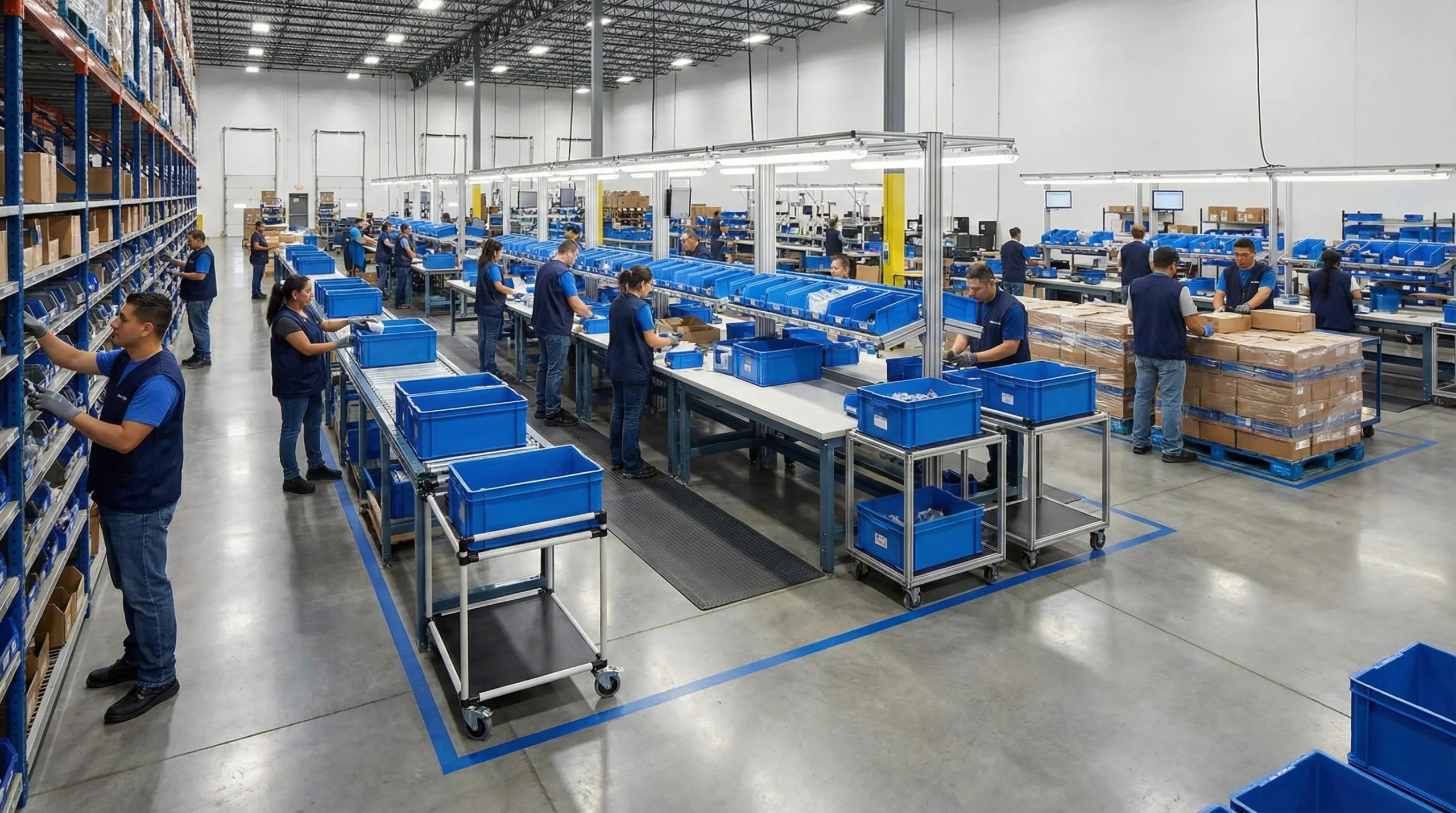
The Warehouse Kitting Process: Step-by-Step Implementation
Successful warehouse kitting requires systematic processes that ensure accuracy, efficiency, and quality. The following step-by-step approach provides a framework for implementing effective kitting operations.
Step 1: Kit Design and Planning
Begin by analyzing sales data to identify products frequently purchased together. Evaluate customer feedback, seasonal trends, and promotional opportunities to determine which product combinations would benefit from kitting.
Define kit specifications including all components, quantities, packaging requirements, and quality standards. Create detailed kit instructions with photos or diagrams showing proper assembly and packaging procedures.
Establish kit SKUs in your warehouse management system with appropriate inventory tracking, location assignments, and reorder parameters. Plan kit quantities based on demand forecasts and inventory turnover goals.
Step 2: Component Sourcing and Staging
Identify optimal staging areas for kitting operations, considering workflow efficiency and space utilization. Designate specific zones for component storage, assembly work, and completed kit storage.
Pull component inventory from primary storage locations and transport to staging areas. Organize components by kit type and implement batch picking strategies to minimize travel time during assembly.
Verify component quality and completeness before beginning assembly. Check expiration dates, inspect for damage, and ensure all items meet quality standards specified in kit instructions.
Step 3: Kit Assembly
Follow standardized assembly procedures to ensure consistent kit quality and completeness. Use picking lists or digital instructions that clearly specify component quantities and assembly sequences.
Implement quality checkpoints throughout the assembly process. Common checkpoints include component verification, quantity confirmation, and final completeness inspection.
Package completed kits according to specifications, including protective materials, inserts, and labeling requirements. Ensure packaging protects components during storage and shipping while facilitating easy unpacking for customers.
Step 4: Quality Control and Documentation
Conduct final quality inspections on completed kits, checking for completeness, proper packaging, and label accuracy. Document any issues or deviations from standard procedures.
Update inventory records to reflect component consumption and kit creation. Ensure your WMS accurately tracks the transformation of individual components into kit inventory.
Generate kit identification labels with unique barcodes or RFID tags for inventory tracking. Include kit contents, assembly date, and quality control approval information.
Step 5: Storage and Inventory Management
Transport completed kits to designated storage locations optimized for picking efficiency. Consider kit size, weight, and order frequency when determining storage assignments.
Implement appropriate storage conditions for kit components, considering temperature requirements, expiration dates, and handling sensitivity. Monitor storage environments to maintain kit quality over time.
Establish cycle counting procedures for kit inventory, including periodic component verification to ensure kit integrity and accuracy.
Benefits of Warehouse Kitting
Implementing warehouse kitting delivers measurable operational improvements across multiple aspects of warehouse management and customer service.
Saves Warehouse Space
Kitting optimizes space utilization by consolidating multiple items into single storage units. Instead of dedicating separate locations for each component, kits require only one storage position per complete product set.
This consolidation particularly benefits facilities with limited space or high SKU diversity. A cosmetics retailer creating travel-size kits might reduce storage requirements by 60% compared to storing each sample product separately.
Space savings extend beyond primary storage to picking, packing, and staging areas. Fewer storage locations mean reduced facility requirements and more efficient space utilization throughout the warehouse.
Reduces Travel and Pick Time
Kitting dramatically reduces picker travel time by eliminating the need to visit multiple locations for related products. Instead of traveling across the warehouse to gather several items, pickers visit one location to collect a complete kit.
This efficiency improvement compounds with order volume. A warehouse processing 1,000 orders daily might save 2-3 hours of picker travel time through effective kitting strategies.
Reduced travel time also decreases picker fatigue and increases overall productivity. Workers can process more orders per shift while experiencing less physical stress from warehouse navigation.
Cuts Shipping and Packing Costs
Kitting enables more efficient packaging by optimizing box sizes and reducing packaging materials. Pre-assembled kits often fit into smaller shipping containers compared to separately packed components.
Consolidated packaging reduces shipping costs through better dimensional weight optimization. A electronics kit containing cables, adapters, and accessories might ship in a small box versus a larger package required for separately shipped components.
Packaging efficiency extends to material costs, with kits requiring fewer boxes, cushioning materials, and protective inserts compared to multi-item shipments.
Improves Order Accuracy
Kitting improves accuracy by pre-validating product combinations and reducing picking errors. Quality control during kit assembly catches mistakes before orders ship, eliminating the need for costly returns and re-shipments.
Simplified picking processes reduce human error opportunities. Picking one kit versus multiple components decreases the chance of missing items, selecting wrong quantities, or choosing incorrect product variations.
Accuracy improvements particularly benefit complex orders with multiple related components. Medical supply kits ensure healthcare providers receive complete, compatible product sets rather than potentially missing critical items.
Enhances Customer Experience
Kitting improves customer satisfaction by delivering complete, ready-to-use product sets. Customers receive everything needed for their intended purpose without separately sourcing additional components.
Professional packaging and presentation create positive unboxing experiences that strengthen brand perception. Well-designed kits demonstrate attention to customer needs and product knowledge.
Faster shipping times result from streamlined fulfillment processes. Kitted products often ship same-day versus multi-day processing required for complex, multi-component orders.
Types of Warehouse Kitting
Different kitting approaches serve various operational requirements and customer demands. Understanding these variations helps warehouse managers choose optimal strategies for their specific situations.
Pre-Built Kitting
Pre-built kitting involves assembling product combinations before receiving customer orders. This proactive approach creates kit inventory that exists as sellable units in the warehouse management system.
Pre-built kits work best for predictable product combinations with consistent demand patterns. Seasonal promotions, subscription box contents, and standard product bundles benefit from pre-built approaches.
This strategy requires accurate demand forecasting to avoid overstocking or stockouts of specific kit configurations. Successful pre-built kitting relies on historical sales data and market trend analysis.
Implementation requires dedicated kit assembly time, storage space for completed kits, and inventory management procedures that track both component and kit-level inventory.
On-Demand Kitting
On-demand kitting assembles product combinations after receiving customer orders. This reactive approach provides maximum flexibility while maintaining kitting benefits during order fulfillment.
On-demand strategies work well for customizable products, low-volume combinations, or situations where demand patterns are difficult to predict. B2B operations often use on-demand kitting for customer-specific configurations.
This approach requires efficient assembly processes that don’t delay order fulfillment. Successful on-demand kitting depends on optimized component staging and streamlined assembly workflows.
Implementation focuses on rapid assembly capabilities, component availability, and quality control processes that maintain accuracy under time pressure.
Hybrid Kitting Approaches
Many operations combine pre-built and on-demand strategies to optimize efficiency and flexibility. Popular combinations include pre-built base kits with on-demand customization options.
Hybrid approaches might involve pre-assembling core components while adding variable elements based on customer selections. This strategy balances operational efficiency with customer personalization requirements.
Kitting for Different Industries
Various industries leverage warehouse kitting to address specific operational challenges and customer requirements. Understanding industry-specific applications helps identify relevant implementation strategies.
E-commerce Kitting
E-commerce operations use kitting to create product bundles that increase average order values while simplifying customer purchasing decisions. Common applications include gift sets, starter packs, and complementary product combinations.
Beauty retailers might create seasonal skincare kits containing cleanser, moisturizer, and sunscreen. Electronics retailers often kit charging cables, adapters, and accessories with main products.
E-commerce kitting requires careful attention to packaging aesthetics, unboxing experiences, and return handling procedures. Kits must create positive customer impressions while maintaining cost-effective fulfillment operations.
Success factors include accurate demand forecasting, seasonal planning, and integration between e-commerce platforms and warehouse management systems.
Manufacturing Kitting
Manufacturing operations use kitting to organize components for production lines, maintenance activities, and quality control processes. Kits ensure complete part sets reach assembly stations without delays or missing components.
Automotive manufacturers might create engine assembly kits containing all gaskets, bolts, and components required for specific engine models. This approach eliminates production delays caused by missing parts.
Manufacturing kitting emphasizes accuracy and completeness over packaging aesthetics. Quality control focuses on ensuring all components meet specifications and compatibility requirements.
Critical success factors include precise component specifications, quality control procedures, and integration with production planning systems.
Subscription Box Kitting
Subscription services rely heavily on kitting to create curated product experiences for regular subscribers. These operations must balance variety, cost control, and packaging efficiency across multiple shipment cycles.
Beauty subscription services might create monthly kits featuring sample products, full-size items, and educational materials. Food subscription services kit meal ingredients with recipe cards and cooking instructions.
Subscription kitting requires flexible processes that accommodate product variety while maintaining consistent packaging and shipping schedules. Operations must handle seasonal variations and subscriber preference changes.
Success depends on supplier coordination, inventory management, and customer preference tracking systems that enable personalized kit creation.
Best Practices for Warehouse Kitting
Implementing effective warehouse kitting requires attention to operational details, quality control, and continuous improvement processes.
Design Efficient Kit Configurations
Analyze component sizes, weights, and packaging requirements when designing kit configurations. Optimize packaging efficiency by selecting components that fit well together and minimize shipping costs.
Consider seasonal factors, shelf life requirements, and customer usage patterns when determining kit contents. Avoid including items with significantly different expiration dates or storage requirements.
Test kit configurations with small batches before full-scale implementation. Gather feedback from assembly teams, shipping personnel, and customers to identify improvement opportunities.
Implement Robust Quality Control
Establish quality checkpoints throughout the kitting process, from component verification through final packaging inspection. Document quality standards and train all team members on proper procedures.
Use barcode scanning or RFID technology to verify component accuracy during assembly. Implement exception handling procedures for damaged, expired, or incorrect components.
Track quality metrics including assembly accuracy, customer complaints, and return rates. Use this data to identify process improvements and training needs.
Optimize Kit Storage and Handling
Design kit storage locations based on order frequency, kit size, and handling requirements. Place high-velocity kits in easily accessible locations near packing areas.
Consider kit shelf life when determining storage rotations and inventory turnover procedures. Implement first-in-first-out (FIFO) procedures for kits containing time-sensitive components.
Train warehouse staff on proper kit handling procedures to maintain component integrity during storage and picking activities.
Monitor and Measure Performance
Track key performance indicators including kitting productivity, accuracy rates, and cost per kit. Compare kitting performance against traditional multi-item picking to validate efficiency gains.
Monitor customer satisfaction metrics including order accuracy, shipping times, and return rates for kitted versus non-kitted orders.
Regularly review kit configurations and demand patterns to identify optimization opportunities or outdated kit designs that should be discontinued.
How WMS Software Supports Kitting Operations
Modern warehouse management systems provide essential functionality for managing complex kitting operations efficiently and accurately.
Kit Configuration Management
WMS software enables detailed kit configuration setup including component lists, quantities, and assembly instructions. The system maintains relationships between individual components and finished kits, supporting accurate inventory tracking and cost accounting.
Advanced systems support multi-level kits where sub-assemblies become components of larger kits. This functionality accommodates complex product hierarchies common in manufacturing and technical industries.
Configuration management includes version control for kit specifications, allowing updates and modifications while maintaining historical accuracy for completed kits.
Work Order Generation and Management
WMS systems generate kit assembly work orders based on demand forecasts, inventory levels, or customer orders. Work orders specify required components, assembly locations, and quality control requirements.
The system optimizes work order scheduling based on component availability, assembly capacity, and priority requirements. This scheduling ensures kit availability when needed while minimizing inventory carrying costs.
Real-time work order status tracking provides visibility into assembly progress, completion rates, and potential delays that might impact customer orders.
Inventory Transformation Tracking
WMS software accurately tracks inventory transformations as individual components are consumed and converted into kit inventory. This tracking maintains accurate inventory levels for both components and finished kits.
The system handles complex inventory transactions including component allocations, kit creation, and quality hold procedures. Accurate tracking supports financial reporting and inventory valuation requirements.
Advanced systems support kit disassembly processes for handling returns, defects, or configuration changes that require breaking down completed kits.
Quality Control Integration
Modern WMS platforms integrate quality control checkpoints throughout the kitting process. The system enforces quality procedures and documentation requirements at each assembly stage.
Quality control features include component verification, inspection checklists, and approval workflows that ensure consistent kit quality before release to inventory.
Exception handling capabilities manage quality issues including component defects, missing items, or assembly errors that require investigation and resolution.
Performance Analytics and Reporting
WMS analytics provide insights into kitting performance including assembly productivity, accuracy rates, and cost analysis. These metrics support continuous improvement initiatives and operational planning.
Advanced reporting capabilities track kit performance across multiple dimensions including demand patterns, seasonal variations, and profitability analysis.
Integration with business intelligence tools enables comprehensive analysis of kitting impact on overall warehouse performance and customer satisfaction.
Getting Started with Warehouse Kitting
Successful kitting implementation requires careful planning, phased deployment, and ongoing optimization based on operational experience.
Assess Kitting Opportunities
Begin by analyzing current operations to identify products frequently ordered together. Review sales data, customer feedback, and seasonal trends to prioritize potential kitting opportunities.
Evaluate operational benefits including space savings, labor efficiency, and customer experience improvements. Calculate potential return on investment for different kitting scenarios.
Consider infrastructure requirements including assembly space, storage capacity, and WMS functionality needed to support kitting operations.
Start with Pilot Programs
Launch kitting initiatives with small-scale pilot programs focused on high-opportunity product combinations. Pilot programs allow testing and refinement of processes before full-scale implementation.
Select pilot products with predictable demand patterns and straightforward assembly requirements. This approach minimizes risk while providing learning opportunities.
Monitor pilot performance carefully, gathering feedback from assembly teams, fulfillment staff, and customers. Use pilot results to refine processes and identify scaling opportunities.
Develop Standard Operating Procedures
Create detailed procedures covering all aspects of kitting operations from kit design through quality control and inventory management. Document assembly instructions, quality standards, and exception handling procedures.
Train staff on kitting procedures and quality requirements. Ensure understanding of accuracy standards and their impact on customer satisfaction.
Implement continuous improvement processes that capture feedback and optimize procedures based on operational experience.
Scale Based on Success
Expand kitting operations gradually based on pilot program results and operational capacity. Prioritize scaling opportunities that deliver maximum benefit with manageable complexity.
Monitor performance metrics throughout scaling to ensure maintained quality and efficiency. Adjust procedures and resources as needed to support increased kitting volume.
Continue evaluating new kitting opportunities as business requirements evolve and operational capabilities mature.
Frequently Asked Questions
What types of businesses benefit most from kit building services?
E-commerce retailers, distributors, and manufacturers who sell bundled products or need to assemble components for customers benefit most from kit building. Businesses handling shopping cart orders, subscription boxes, or custom product configurations find kit building essential for streamlining operations and meeting customer demands for assembled items.
How long does it typically take to set up kit building workflows?
Setup time varies depending on your inventory complexity and number of kit types, but most businesses can establish basic kit building workflows within a few days to weeks. The initial Bill of Materials creation and staff training are the primary time investments, with ongoing setup becoming faster as teams gain experience.
Why do customers prefer receiving assembled kits versus individual components?
Customers value the convenience of receiving ready-to-use products without assembly hassle, which saves them time and reduces potential errors. Pre-assembled kits also ensure compatibility between components, provide a premium unboxing experience, and eliminate the frustration of missing parts or incorrect assembly instructions.
When should a company invest in automated kit building solutions?
Companies should consider automated kit building when processing high volumes of multi-component orders, experiencing frequent picking errors, or struggling with manual assembly bottlenecks. The investment typically pays off when kit volume exceeds what staff can efficiently handle manually while maintaining accuracy and speed standards.
What are the main challenges companies face when starting kit building?
The primary challenges include accurately forecasting component demand, managing inventory shortages that delay kit completion, and training staff on new assembly processes. Companies also struggle with tracking component costs for proper pricing and coordinating picking workflows to maintain efficiency while ensuring quality control.