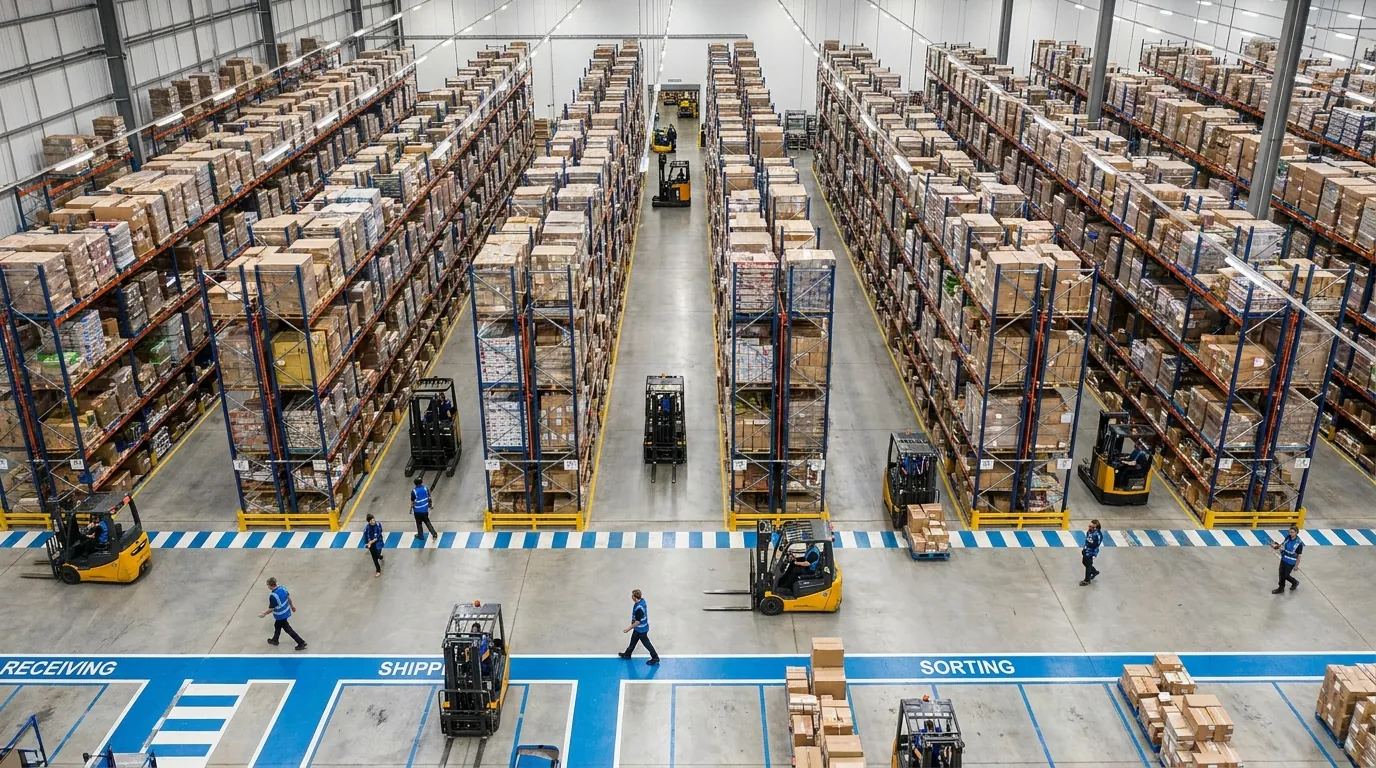

Introduction to Warehouse Cycle Counting
Warehouse cycle countingCycle CountingA method of counting inventory items in a series of small subsets, called “cycles,” rather than performing a full inventory count all at once.View full definition → is a systematic method of auditing inventory in a warehouse. Unlike traditional physical counts, cycle counting involves regularly counting a subset of inventory to ensure accuracy and identify discrepancies. This approach not only saves time but also helps in maintaining a high level of inventory accuracyInventory AccuracyThe degree to which the inventory quantity and location records within an inventory management system match the physical inventory in a warehouse.View full definition → throughout the year. Implementing warehouse cycle counting can significantly enhance operational efficiency and reduce the risk of inventory errors.

Smarter Warehouse Management Starts Here
Logimax WMS delivers real-time visibility, automated workflows, and seamless ERP integration for warehouses of every size.
Request a Demo
Understanding Cycle Counting Meaning and Its Importance
Cycle counting refers to the process of counting a small portion of inventory on a regular basis. By understanding the cycle counting meaning, warehouse managers can implement strategies that reduce errors and improve inventory accuracy. This section will explore why cycle counting is crucial for modern warehouses and how it contributes to better inventory management. Regular cycle counts allow for the timely identification of discrepancies, which can then be swiftly addressed, thereby reducing the impact of errors on the overall supply chain.
Warehouse cycle counting is not just about maintaining inventory levels; it's also about ensuring that the data used for business decisions is accurate. According to the American Production and Inventory Control Society (APICS), accurate inventory data is crucial for efficient supply chain management. By continuously validating inventory records, businesses can enhance their forecasting accuracy and improve customer satisfaction.

Best Practices for Warehouse Inventory Management
Effective warehouse inventory management is essential for operational success. Implementing best practices such as categorizing inventory, prioritizing high-value items, and using technology can enhance cycle counting effectiveness. This section will provide practical tips for optimizing inventory management in your warehouse. For instance, integrating a warehouse management system can streamline inventory processes and improve accuracy. Additionally, regularly training staff on inventory procedures can prevent errors and ensure smooth operations.
Prioritizing inventory based on value and frequency of use can also help focus efforts on the most critical items. Moreover, leveraging data analytics can provide insights into inventory trends and help adjust strategies accordingly, as discussed in our article on maximizing warehouse efficiency.

Technological Advancements in Cycle Counting
Technology plays a pivotal role in modern cycle counting processes. From barcode scanningBarcode ScanningA method of capturing information stored on a barcode attached to a product, package, or location using optical scanning technology.View full definition → to RFIDRFIDA wireless technology that uses radio waves to automatically identify and track tags attached to objects, eliminating the need for direct line-of-sight scanning.View full definition → systems, technological advancements have streamlined the cycle counting process, making it more accurate and efficient. This section will highlight the latest technologies that are transforming cycle counting in warehouses. For example, automated data collection tools and inventory management software provide real-time visibility and reduce manual errors. These technologies facilitate better decision-making and enhance overall warehouse efficiency.
Advancements such as Internet of Things (IoT) devices and machine learning are also beginning to make an impact by providing predictive analytics and further reducing the margin of error. As outlined in our top warehouse technology trends, these tools are crucial for staying competitive in the fast-evolving logisticsLogisticsThe comprehensive management of the flow of goods, information, and resources from the point of origin to the point of consumption, encompassing planning, implementation, and control of efficient movement and storage.View full definition → landscape.
Common Challenges and Solutions in Cycle Counting
Despite its benefits, cycle counting can present challenges such as human error and resource allocation. This section will discuss common challenges faced by warehouse managers and provide solutions to overcome them, ensuring a successful cycle counting implementation. For example, over-reliance on manual processes can lead to errors; adopting automated systems can mitigate this risk. Additionally, effective scheduling and resource management can help ensure that cycle counts do not disrupt daily operations.
A common challenge is the allocation of labor resources, especially during busy periods. Implementing a flexible workforce strategy can help overcome this issue. Furthermore, regular audits and process reviews can ensure continuous improvement in cycle counting practices. The Warehousing Education and Research Council (WERC) offers resources and best practices to help warehouses tackle such challenges effectively.
Case Studies: Real-World Applications of Cycle Counting
Consider a retailer that implemented cycle counting to improve their inventory accuracy. By regularly auditing their stock, they were able to reduce discrepancies significantly and optimize their replenishmentReplenishmentThe process of moving or resupplying inventory from a reserve (or upstream) storage location to a primary (or downstream) storage or picking location, or to another facility.View full definition → processes. Another example is a logistics company that used RFID technology to enhance their cycle counting procedures, resulting in quicker and more precise counts. These hypothetical scenarios illustrate how various challenges can be addressed and the tangible benefits achieved through effective cycle counting practices. For further insights on maximizing efficiency, see our blog on maximizing warehouse efficiency: key strategies for success.
In another hypothetical scenario, a cold storageCold StorageA specialized warehousing environment that maintains controlled low temperatures to preserve perishable goods and extend their shelf life.View full definition → facility facing frequent inventory inaccuracies switched to a cycle counting system. By prioritizing critical and perishable items, they managed to reduce spoilage and improve service levels, demonstrating the adaptability of cycle counting in different environments. For those operating in specialized sectors, our article on choosing a warehouse management system for your cold storage warehouse offers additional insights.
Frequently Asked Questions
What is warehouse cycle counting?
Warehouse cycle counting is a method of auditing inventory by counting a subset of items regularly to maintain accuracy and identify discrepancies.
Why is cycle counting important?
Cycle counting is important because it ensures ongoing inventory accuracy, reduces errors, and improves supply chain efficiency.
How can technology improve cycle counting?
Technology like barcode scanning, RFID, and IoT devices enhance accuracy and efficiency, reducing manual errors in cycle counting.
What are common challenges in cycle counting?
Common challenges include human error and resource allocation, which can be mitigated with automated systems and flexible workforce strategies.
Can cycle counting be applied to cold storage warehouses?
Yes, cycle counting can be adapted for cold storage warehouses by prioritizing critical and perishable items to reduce spoilage and improve service levels.